Truck-Mounted Concrete Pumps: What They Are, When to Use Them, Configurations, and Dimensions

Back

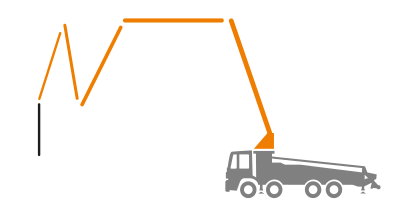
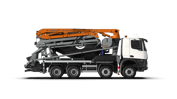
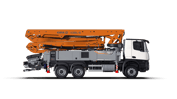
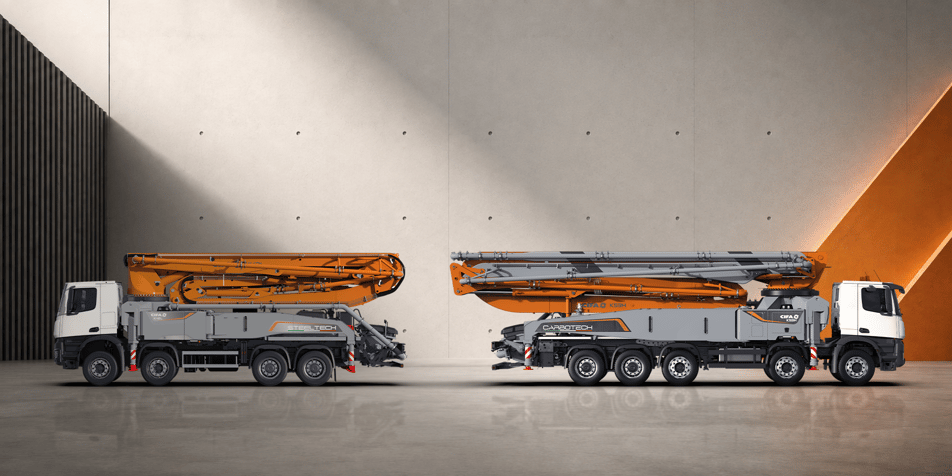
Truck-mounted concrete pumps are among the most widely used pieces of equipment for pumping and distributing concrete on jobsites. 
Thanks to the combination of truck, pumping unit, and placing boom, these machines make it possible to transport concrete directly to the pouring point, even when the work area is far away or difficult to access.
 

What ss a truck-mounted concrete pump?

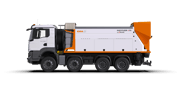
A truck-mounted concrete pump is a piece of equipment for pumping concrete that is installed on a truck.

The machine integrates three main elements:

  • Pumping unit
  • Articulated placing boom
  • Stabilization system that ensures safety during operations

Concrete is discharged from the mixer truck into the hopper of the pumping unit. From there, through two cylinders working alternately, the material is drawn in and then pushed through the delivery pipeline to the pouring point.

This solution overcomes the logistical limits of traditional concrete transport and makes it possible to reach difficult areas of the jobsite with precision, even over considerable distances or at significant heights.


Operational challenges on construction sites

On construction sites, the concrete pouring phase can be affected by complex operational variables:

  • Vertical development of buildings
  • Limited space
  • Non-negotiable deadlines
  • The need to avoid machine downtime
  • Continuity of operations
  • Precision even in difficult conditions
  • Scalability across very different types of jobsites
  • The economic sustainability of the project

Construction companies must choose solutions capable of meeting these requirements.

In this context, truck-mounted concrete pumps become a strategic operational asset, but only if they are configured correctly.


Configuration and dimensions

Choosing a truck-mounted concrete pump starts with defining a configuration that is consistent with the type of work it will need to perform.

The boom, pumping unit, geometry, and truck configuration work together and must be evaluated as a single system, because jobsite performance depends on their combination.


Boom length

Truck-mounted concrete pumps cover a very wide range of boom lengths, generally from 20 up to 80 meters.
To make the choice easier, it is useful to divide the configurations into three main operational groups:

Up to 30 meters

These configurations are designed for:

  • Urban jobsites with limited space
  • Small- to medium-scale residential construction
  • Situations where maneuverability is the priority

They are compact machines, easier to position, and subject to fewer logistical constraints.

Between 30 and 40 meters

These represent the most versatile segment.

They are used for:

  • Multi-story buildings
  • Standard residential and commercial jobsites
  • Work that requires a balance between reach and vehicle compactness

In many markets, they are the most widely used because they cover the majority of applications.

Between 40 and 50 meters

These configurations are designed for:

  • More complex jobsites
  • Greater vertical development
  • The need to cover wide areas without repositioning

They are among the most widely used because they make it possible to increase productivity while reducing cycle times.

Over 50 meters: specialist applications

Pumps with booms ranging from 50 to 67 meters are dedicated to:

  • Large infrastructure projects
  • Skyscrapers
  • Jobsites with limited access but significant vertical development

Here, the choice is driven by the need to reach the pouring point when there are no practical operational alternatives.

Number of sections and boom geometry

The boom consists of 4 to 7 sections, and its geometry affects:

  • The ability to work in confined spaces
  • Ease of unfolding
  • Pouring precision
  • Reduced movement of the machine

The main boom configurations differ according to their geometry and mode of use:

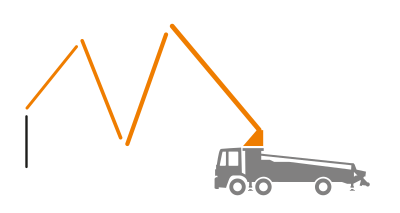
Icona braccio_Z Type

Z configuration

Allows fast unfolding operations for concrete pouring both near to and far from the pump.
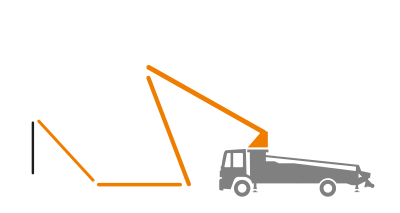
Icona braccio_ZR Type

ZR configuration

Suitable for unfolding the boom inside buildings and for pouring concrete close to the pump.
Icona braccio_RZ Type

RZ configuration

Ideal for five- or six-section booms and designed to offer high flexibility through the combination of R and Z geometries.

Weight and materials

One of the main limitations of long booms is weight. As length increases, so do:

  • Structural loads
  • Stress on the chassis
  • Stabilization requirements

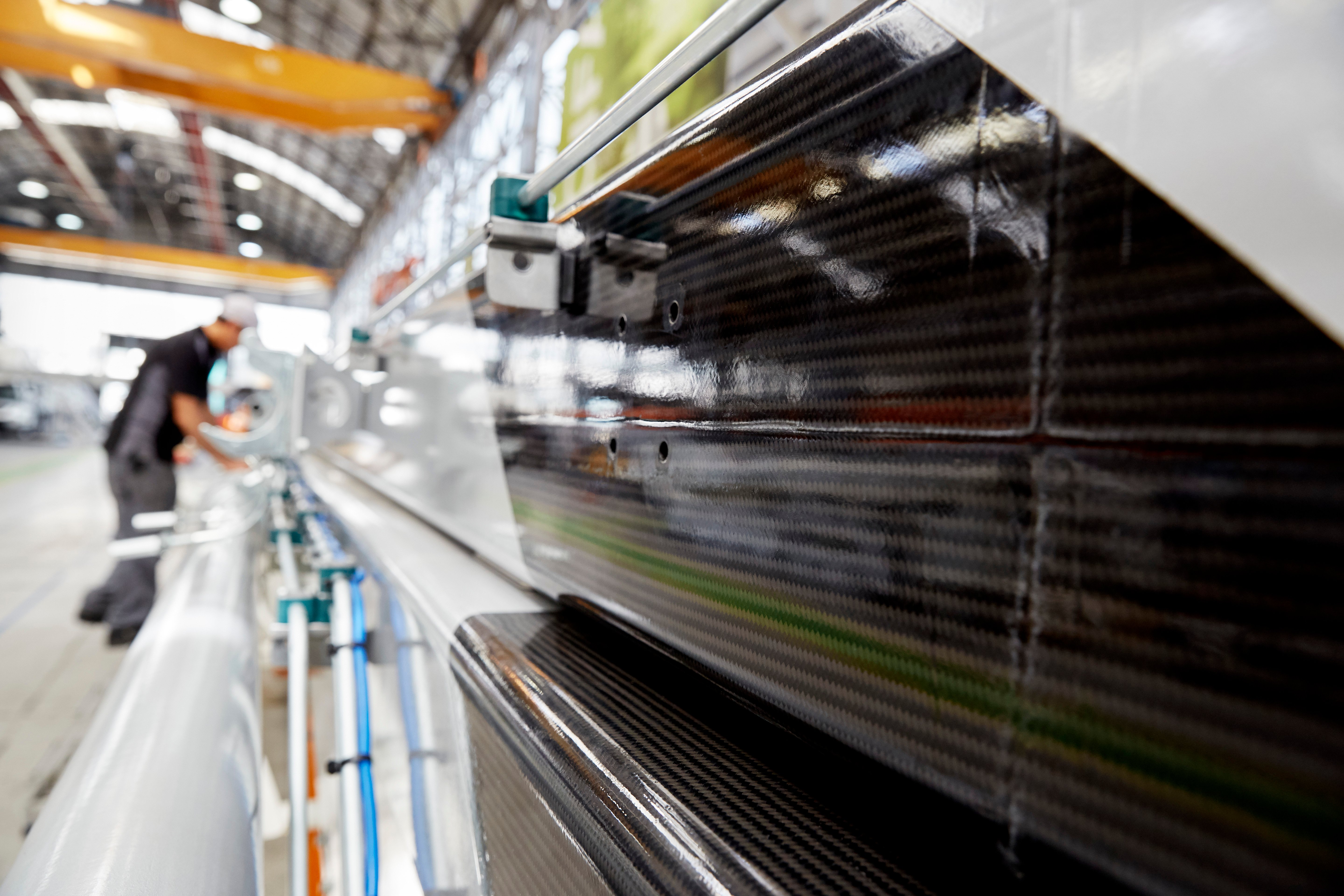
The use of carbon fiber in booms makes it possible to overcome these limitations:

  • Longer booms at the same weight
  • Greater rigidity during pouring
  • Less vibration
  • Longer service life
  • Better fatigue resistance

This material makes it possible to increase performance without compromising stability and safety.
 

Carbotech 1


Pumping Unit: real-world jobsite performance

To evaluate a machine correctly, it is necessary to consider a few key technical parameters of the pumping unit:

  • Concrete output (m³/h).
    This indicates the quantity of material moved and directly affects the speed of jobsite progress.
  • Concrete pressure (bar).
    This determines the ability to work at height or over long distances, especially when complex delivery lines are involved.
  • Cylinder diameter and stroke. These influence the amount of concrete pumped in each cycle and the regularity of the flow.
  • Number of cycles per minute.
    This affects pumping continuity and the balance between performance and wear.
  • Circuit type (open or closed).
    More advanced systems provide greater control and more stable performance.
  • Control system.
    Electronic management makes it possible to adapt the machine to real working conditions.

Pumping units generally cover a wide performance range, from configurations suited to standard jobsites to solutions designed for long distances, great heights, and high volumes.


Truck configuration

Truck configuration depends on the machine’s overall dimensions and, above all, on boom length. As the boom length, weight, and stability requirements increase, the number of axles needed to properly support the setup also increases.


For this reason, a truck-mounted concrete pump can be installed on trucks with anywhere from 2 to 7 axles.


A few examples help clarify this relationship:

Boom length Truck configuration
20 meters 2 axles
40 meters 3 axles
60 meters 6 axles
Over 60 meters 6–7 axles

The different types of trucks directly affect investment costs, load capacity, jobsite accessibility, and specific road circulation requirements, all of which must be evaluated according to the operating context and the type of project.


Advantages of choosing the right truck-mounted concrete pump

A properly configured truck-mounted concrete pump delivers direct operational benefits throughout the entire work cycle.

Greater productivity

  • Reduced pouring times
  • Fewer repositionings
  • Higher operating speed

Operational continuity

  • Less machine downtime
  • Greater reliability
  • More stable workflows

Economic optimization

  • Reduced indirect costs
  • Better use of resources
  • Greater project control

Greater safety

  • Better control of the pour
  • Less manual intervention
  • Greater machine stability

Truck-mounted concrete pumps are key tools for managing the complexity of modern jobsites. But their value depends on choosing the right configuration: boom length, materials, pumping unit, and truck setup must all be aligned with the type of work to be carried out.


For construction companies, this means turning a machine into a real competitive advantage.

FAQ

Frequently asked questions

  • When is it worth choosing a carbon-fiber boom?

    When long reach, lower weight, and greater operational stability are needed. It is a sensible choice for medium- to long-boom machines and for applications where rigidity and reduced oscillation affect pouring quality.
  • In which cases does the number of axles really affect the choice?

    When the jobsite imposes access restrictions, weight constraints, or requires greater stability. For the same boom length, the operating context can lead to different truck chassis solutions.
  • When should a closed-circuit pumping unit be preferred?

    When consistent performance, more precise control, and the ability to work over demanding distances or heights are required. An open circuit remains suitable where ease of operation is the priority.

Subscribe to the newsletter