Shotcrete in Tunnels: How to Plan Spraying Operations and Select Equipment

Back
Shotcrete in Tunnels

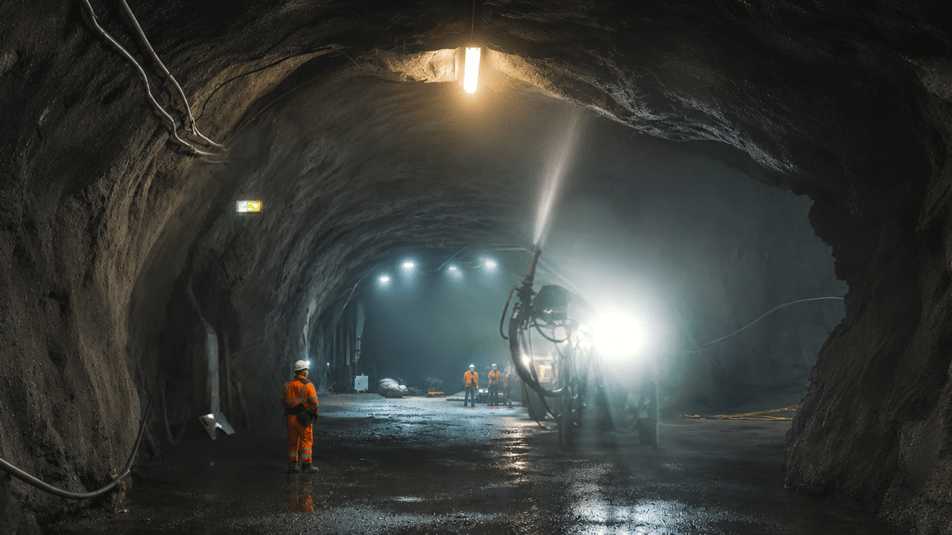
Each excavation advance leaves a stretch of rock or ground unsupported. Whether excavation uses blasting or mechanical methods, this exposed ground needs to be secured quickly. The longer it remains unsupported, the more the ground relaxes and deforms, increasing the risk of exceeding design limits or allowing blocks to fall.

Shotcrete is often the first form of support installed, and how it is applied affects safety, advance rates and costs. Underground, however, the tunnel cross-section varies, access routes are long, and spraying has to be coordinated with mucking out (removing excavated material) and the installation of rock bolts and steel ribs. Concrete is supplied from outside the tunnel, with delivery times that are not always predictable.


What is shotcrete?

Shotcrete, also known as sprayed concrete or spritz beton, is a cementitious material projected at high velocity through a nozzle onto the surface to be lined. Application and compaction take place together: the impact compacts the material, without formwork or vibration. To adhere even to the crown, the upper part of the tunnel, the layer must set very quickly. An accelerator is therefore added to the mix.

Tunnel support has two distinct stages:

  • Initial support: shotcrete, steel ribs and rock bolts installed during excavation to stabilise the ground;

  • Permanent lining: usually cast-in-place concrete, installed once deformation of the initial support is subsiding at an acceptable rate; precast segments are used with shielded TBMs.

In some projects, shotcrete works together with the final lining or forms the final lining itself (sprayed concrete lining, SCL). Its role is defined by the design.

The excavation method influences how shotcrete is used. In drill and blast tunnelling, it supports the excavation alongside rock bolts after each blast. In NATM (New Austrian Tunnelling Method), it is the central element of a support system adapted to measured deformation. In ADECO-RS (Analysis of Controlled Deformation in Rocks and Soils), developed in Italy, it complements reinforcement of the core ahead of the face.  With hard-rock TBMs (Tunnel Boring Machines), shotcrete is sprayed manually from a platform close to the cutterhead or by robotic systems further back. 


Seven aspects to check on site

The maximum output on a technical data sheet tells you little about how a machine will perform in a tunnel. What matters is the concrete pump, accelerator dosing, compressed air, nozzle, boom and operator, and how they work together.


1. Project requirements

Check: tunnel cross-section, available headroom, curve radii and passing bays; ramps, gradients and distance from the portal; time available for spraying in each cycle; and the thicknesses, strength classes, fibres or mesh specified in the design.

Selection criteria: machine dimensions, manoeuvrability and boom working envelope must suit the tunnel cross-section, while output must fit the cycle time. An oversized machine cannot manoeuvre, while an undersized one takes longer to complete spraying.


2. Ready-mix and dry-mix shotcrete

Ready-mix: the concrete arrives ready-mixed and is pumped to the nozzle, where compressed air and accelerator are added. The water/cement ratio is set during batching, and dust and rebound are lower. This is the most widely used process underground where large, continuous volumes are required.

Dry mix: the dry components are conveyed by compressed air, with water added at the nozzle. This flexible process suits small quantities, intermittent work and very tight spaces, but produces more dust and rebound and relies heavily on the nozzle operator's skill.

Selection criteria: volume per cycle, continuity of work, supply arrangements, dust limits and ventilation.


3. Mix design and supply

Check: a limited maximum aggregate size (generally 8 mm) and sufficient fines to aid pumping. Silica fume improves mix cohesion and reduces sagging and rebound. Admixtures maintain flowability with a low water content, while fibres improve post-cracking behaviour and affect pumpability. Concrete left waiting too long loses workability.

Selection criteria: a pump and pipelines compatible with the specified mix, with transport organised to keep the machine supplied with concrete.


4. Pumping

Check: the difference between nominal output (on the data sheet), effective output (the rate sustained on site with the actual mix and pumping circuit) and the material that actually remains on the surface after allowing for rebound and stoppages. With the twin-cylinder piston pumps typically used for ready-mix spraying, each piston changeover creates a pulsation that disrupts the spray stream. Fast changeovers, long-stroke pistons, suitable pipelines and electronic cycle control reduce this effect.

Selection criteria: output that can be sustained throughout spraying and a steady flow at the nozzle. 


5. Dosing and spraying

Check: accelerator dosing must track the actual concrete flow rate. If the flow rate changes but dosing does not, setting times change. More advanced systems therefore synchronise the dosing pump with the concrete pump. Nozzle distance and angle are set according to the design and site procedures. As a guide, the literature recommends a distance of 1.5 to 2 m from the surface and spraying as close to perpendicular as possible.

Selection criteria: precise, adjustable dosing, sufficient air supply and a boom that maintains the correct nozzle distance and angle across the entire profile.


6. Rebound

Rebound is material that bounces off the surface and falls to the ground. Coarse aggregate is particularly prone to rebounding, leaving the applied layer richer in cement, with greater shrinkage and a higher risk of cracking. The material on the ground then has to be removed.

Check: the process used (rebound with ready-mixed concrete is two to four times lower), excessive air pressure, coarse or crushed aggregates, a rigid substrate, layer thickness, nozzle distance and angle, and nozzle operator experience.

Selection criteria: steady flow, precise dosing, control of nozzle position and trained operators. No single machine function can eliminate rebound on its own.


7. Level of mechanisation

  • Manual: the nozzle is guided by hand. This is flexible for reprofiling and small volumes, but physically demanding and places the operator close to the face.

  • With a manipulator: a remotely controlled telescopic boom keeps the operator away from unsupported ground, rebound and dust.

  • With a self-propelled shotcrete machine: the carrier, pump, boom and dosing system are integrated into a single machine for large volumes and repetitive cycles.

  • Assisted: some systems automatically repeat nozzle movements or use a laser scan of the profile to maintain nozzle distance and angle. Current state-of-the-art application is semi-automatic, with the operator remaining responsible for the process.

Machine data (flow rates, pressures and dosing rates) help determine whether the mix and pumping circuit are behaving as expected, but do not replace checks on the applied material.

Selection criteria: a level of mechanisation suited to the volumes, tunnel cross-section, operator exposure and available skills.


At a glance

 Site  Requirement Suitable equipment
Large road or railway tunnel High volumes and tight advance schedules Self-propelled ready-mix machine with adequate boom reach, synchronised dosing and transport capacity matched to the cycle
Mine with repetitive advance cycles Manoeuvrability and durability over long shifts Compact machine on an articulated chassis, easy maintenance and a power source suited to the available infrastructure
Small tunnel or heading Working in confined spaces Portable pump with a powered boom, or an ultra-compact machine
Unstable face Immediate support and operator safety Mechanised, radio-controlled spraying, precise dosing and a boom that allows work from a safe distance
Repairs and reprofiling Short, intermittent operations Compact pump that is easy to relocate; ready or dry mix according to volume and continuity of work


CIFA Underground solutions

The output and pressure figures below are theoretical maximum values and may not be achievable simultaneously. 
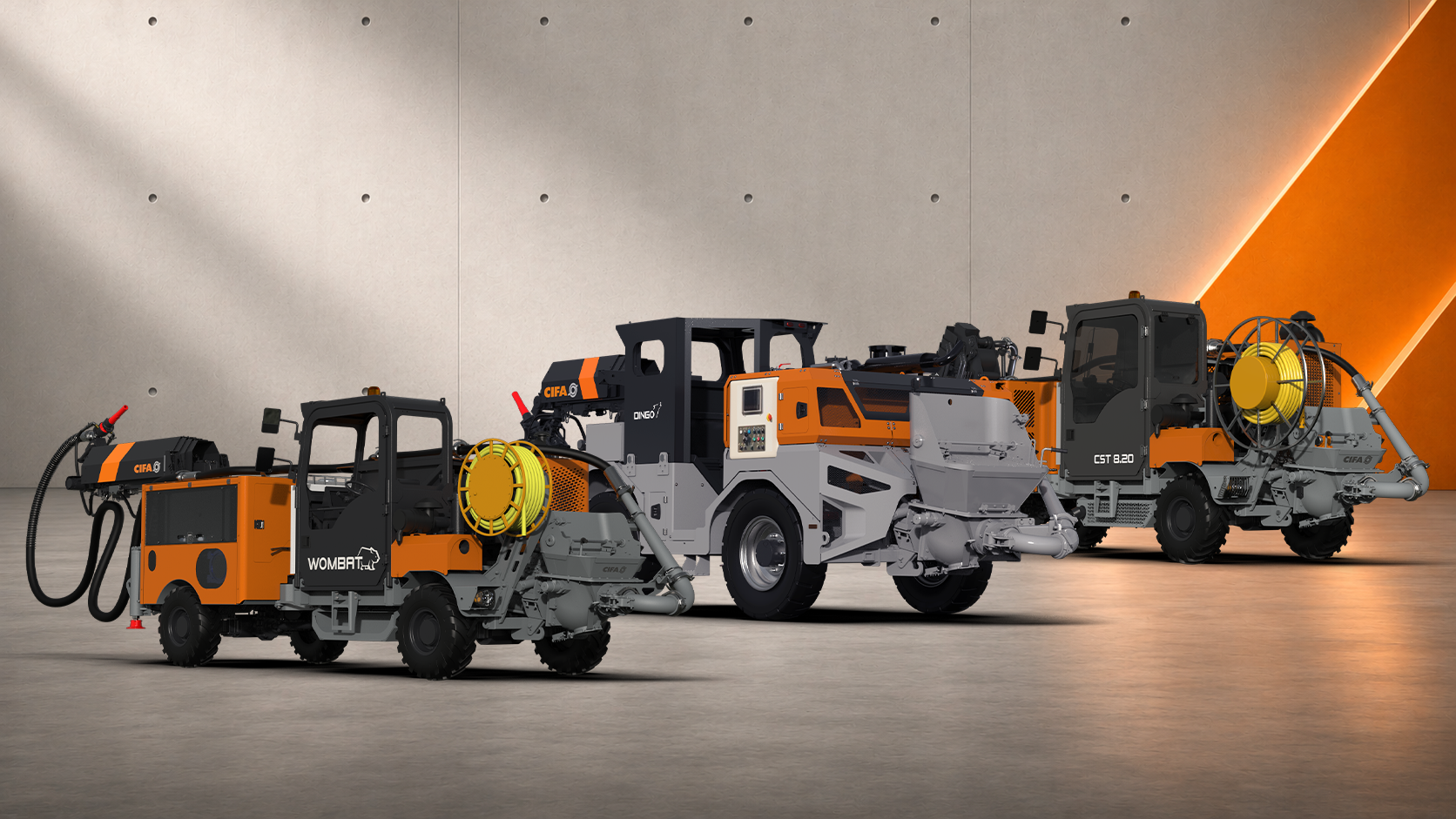
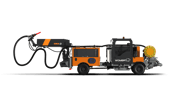
Wombat dingo cst

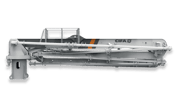
Large tunnels and intensive cycles: ELK and MAMBA

Self-propelled machines integrating the pump, boom and dosing system, with theoretical output of up to 30 m³/h, maximum concrete pressure of 65 bar and diesel or electric power for spraying.

  • ELK is the latest evolution of the CSS series, CIFA's range of spraying systems (also referred to in documentation as CSS-3 EVO). Its three-section boom, with Z folding and a telescopic end section, is mounted on a turret that slides along the machine, covering more surface with fewer machine repositionings. It is designed for large tunnels and intensive mining operations.

  • MAMBA is easy to manoeuvre while retaining the boom reach needed for large tunnels: 18 m vertically and 14 m horizontally, with full unfolding within a space of 4 m.


Mines and small tunnels: WOMBAT, CST 8.20 and DINGO

  • WOMBAT and CST 8.20 are mounted on a compact articulated chassis with a tight turning radius. The boom reaches 10 m vertically, and the pump is driven by an electric motor. CST 8.20 has a theoretical output of 3 to 20 m³/h and a maximum pressure of 65 bar.

  • DINGO has a shotcrete boom, a PAS 306 pumping unit and a theoretical output of up to 30 m³/h. Its 2.2 m wheelbase and 2.5 m height allow it to work in small tunnel cross-sections.


Tight spaces and frequent repositioning: RHINO and MANTIS

  • RHINO is a portable shotcrete pump with a theoretical output of up to 15 m³/h, a maximum pressure of 80 bar and integrated admixture dosing. It is easy to reposition in medium-sized tunnels and for ground stabilisation work.

  • MANTIS is a powered boom with an onboard operator and four sections, three of them telescopic, for small tunnels. It has no pump of its own: it connects to a portable pump equipped with admixture dosing and compressed air, such as RHINO.


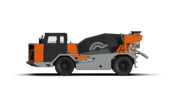
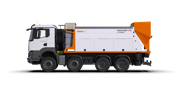
Concrete transport to the face: COGUARO and MYRIA

To keep spraying supplied without interruption, CIFA offers two underground mixers: COGUARO, with a nominal capacity of 4 m³, for small tunnels, and MYRIA, with nominal capacities from 6 to 12 m³, for medium and large underground projects. Matching transport capacity to the cycle reduces waiting time for the spraying machine and limits loss of mix workability.


Electric spraying

On models equipped for it, the machine can run from the site's electrical supply during spraying, reducing exhaust emissions and noise in the work area. The impact on ventilation and costs must be assessed for each site.

FAQ

Frequently asked questions

  • Are shotcrete, sprayed concrete and spritz beton the same thing?

    Yes. “Spritz beton” is a term used on site, while “sprayed concrete” is the term used in UNI EN 14487.

  • Does the output on the data sheet match production on site?

    No. Actual production depends on the mix, pipelines, continuity of supply, work cycle organisation and rebound. Planning should therefore be based on the material actually applied.

  • Does an automated machine replace the operator?

    No. It helps the operator maintain nozzle distance and angle or repeat movements, but qualified personnel remain responsible for the process and quality.

  • How do you choose the right configuration?

    Tunnel cross-section, volumes, access, concrete logistics and available power vary from one site to another. Contact the CIFA Underground team to identify the configuration best suited to your project.

Subscribe to the newsletter