



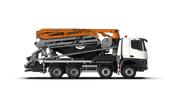
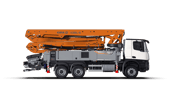

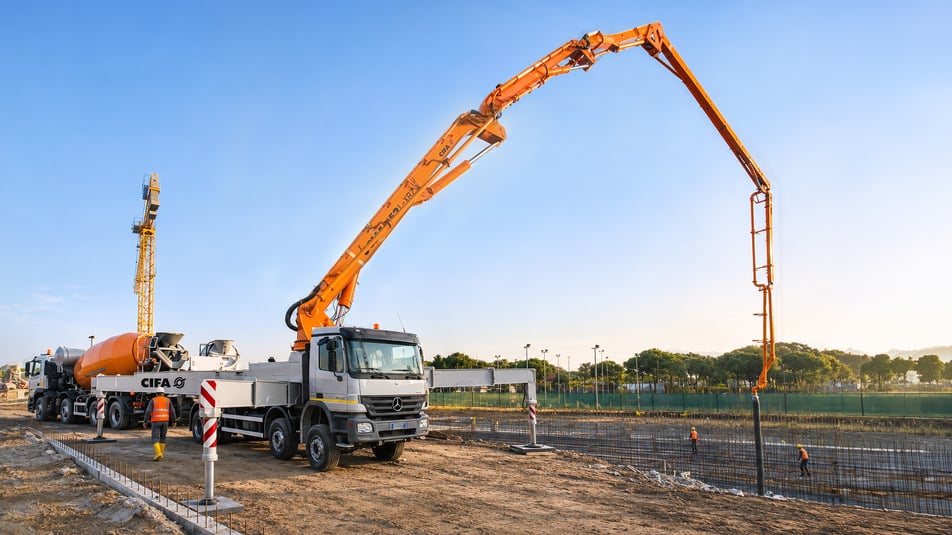
Picture this: the concrete placement point is 25 metres away, but a building stands between the pump and the slab. Or you need to work beneath a low canopy, with very little overhead clearance above the truck. In situations like these, the boom is theoretically long enough, yet the end hose cannot reach the required position, or there is simply no room to unfold the boom. This is where the number of boom sections becomes a key factor in jobsite productivity.
The golden rule is that a fifth section adds another joint, giving the boom an extra point at which to change direction. However, an additional section alone does not guarantee greater reach, a lower unfolding height or millimetre-level precision. These depend on the overall boom geometry: the length of each section, its maximum articulation angle and the folding system.
This article focuses on booms in the 30 to 40 metre range. This is a key category in which CIFA offers both 4- and 5-section solutions with the same overall reach, allowing a direct comparison based on actual operating requirements. (The effects of structural materials, such as high-strength steel and carbon fibre, are covered in our dedicated guide to Carbotech technology).
What changes when you add another joint?
The number of boom sections, together with the unfolding sequence, changes how a truck-mounted concrete pump works on the jobsite.
Each section is connected to the previous one by a joint with its own maximum articulation angle. For the same overall length, a 5-section boom has shorter sections on average and one additional joint. This significantly increases the range of shapes and configurations the boom can adopt:
-
Reaching over obstacles: the boom can rise, clear an obstacle such as a wall or roof, then descend vertically using a shorter, more manoeuvrable section.
-
Working in confined spaces: the boom can articulate and unfold indoors or beneath canopies where the longer sections of a 4-section boom would prevent it from opening.
Other characteristics depend on the engineering of the machine as a whole rather than the number of sections:
-
Maximum working envelope: determined by the overall length and geometric configuration.
-
Minimum unfolding height: depends on the length of the individual sections, the unfolding sequence and the working angles.
-
End hose stability during concrete placing: depends on structural stiffness, weight distribution, hydraulic controls and electronic boom bouncing control systems.
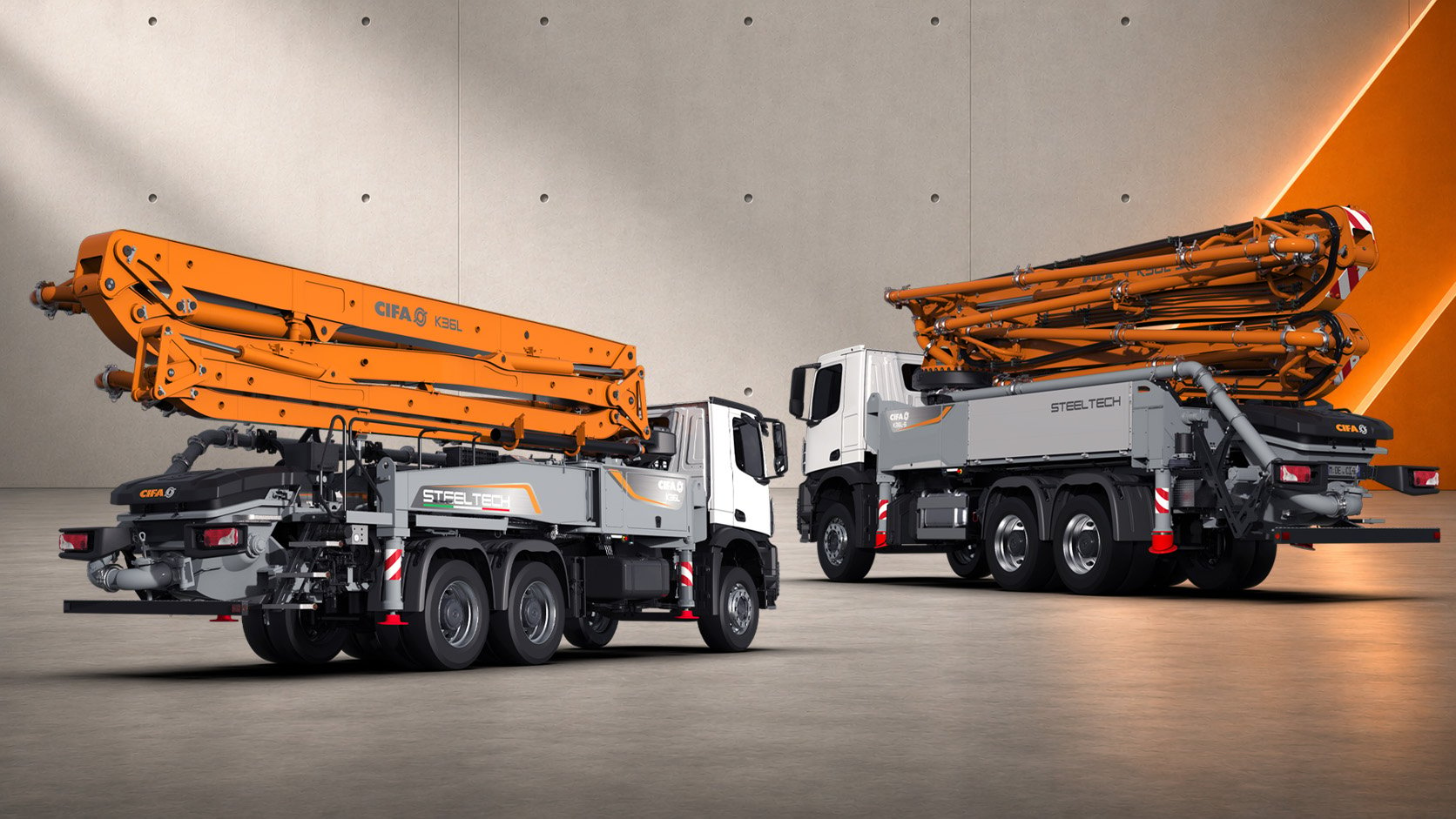
Take the CIFA K36L (4 sections) and K36L-5 (5 sections), for example. Their maximum horizontal reach is almost identical, at 31.2 metres and 31.1 metres respectively, but their articulation angles differ considerably. The K36L offers angles of 90°, 180°, 237° and 250°, while the K36L-5 offers 90°, 180°, 234° and 180°, with a continuous-rotation rotor fitted as standard on the fifth section for maximum freedom of movement.
A closer look at the key 30 to 40 metre range
To understand how boom technology has evolved, let us look at the CIFA range, from the most compact models through to the top-of-the-range machines.
-
K28L: a 4-section Z-folding boom with a minimum unfolding height of 6.2 m. This confirms that a 4-section boom can unfold at a very low height when its sections are short.
-
K31L: a 5-section Z-folding boom that brings the fifth section into the Steeltech range at around the 30-metre mark, adding an extra joint to a highly manoeuvrable machine.
The 30 to 40 m range: comparing CIFA models
In this range, CIFA offers two machines with 36 m booms whose main difference is the number of sections. They provide the most useful comparison for understanding what the fifth section adds.
K36L vs K36L-5
This is the most useful direct comparison: two machines in the same class, both with a gross vehicle weight of less than 26 tonnes, available with the same high-performance pumping units (the closed-loop HP1608EC with Smartronic or the open-loop HP1606H with Easytronic).
The technical data sheets highlight the differences:
| Technical specification (CIFA data sheet) |
K36L (4 sections) | K36L-5 (5 sections) |
| Boom configuration |
4 sections, Z-folding | 5 sections, Z-folding + rotor |
| Maximum vertical reach | 35,6 m | 35,1 m |
| Maximum / net horizontal reach | 31,2 m / 28,4 m | 31,1 m / 28,3 m |
| Minimum unfolding height |
8,4 m | 7,03 m |
| Section articulation angles | 90° / 180° / 237° / 250° | 90° / 180° / 234° / 180° + rotor |
| Final section |
Standard | Continuous-rotation rotor as standard |
| Truck chassis wheelbase (6x4) | 4500 mm | 4200 mm (shorter and more manoeuvrable) |
| Outrigger configuration |
Front X-style telescopic outriggers. Swing-out rear outriggers. | Front X-style telescopic outriggers. Straight telescopic rear outriggers. |
| Gross vehicle weight (GVW) | Less than 26 t | Less than 26 t |
| Standard pumping unit and control system | HP1608EC with Smartronic HP1606H with Easytronic |
HP1608EC with Smartronic HP1606H with Easytronic |
The table shows that the two machines cover virtually the same working area: both maximum and net horizontal reach differ by just 10 cm. The K36L-5 stands out for its additional joint, the rotor on the final section and a minimum unfolding height approximately 1.4 m lower. This last figure is a result of the overall geometry, rather than the number of sections alone.
There is more to this comparison than the boom. The K36L-5 is mounted on a 6x4 truck with a 4200 mm wheelbase, compared with 4500 mm for the K36L, and has telescopic rear outriggers rather than swing-out outriggers. These differences affect the space needed for manoeuvring and outrigger deployment, and they should be considered separately from boom articulation. Your choice should therefore also take account of road access and the types of jobsites you typically work on.
To apply this comparison to your own jobsites, our guide to choosing a 4- or 5-section boom explains how to read the working diagram and check the clearance needed for unfolding.
At the upper end of the range: K38L and K40H
Towards the top of this category, performance depends on a combination of technologies as well as the number of sections:
-
K38L: a 38 m, 4-section Z-folding boom with 37.6 m vertical reach, 33.4 m maximum horizontal reach, a minimum unfolding height of 9.1 m and an actual total weight below 26 t on a 6x4 truck. It is an excellent heavy-duty solution with a 4-section steel boom.
-
K40H: a 40 m, 5-section hybrid steel and carbon fibre boom (Carbotech) with RZ folding, offering 39.1 m vertical reach, 34.5 m maximum horizontal reach and a minimum unfolding height of 8.6 m. What makes it distinctive is its combination of materials. The first three sections are made from high-strength steel, while the fourth and fifth are made from carbon fibre. This dramatically reduces the mass at the boom tip, increasing stability while keeping the machine within the legal limit of 26 tonnes on 3 axles.